

Signs you might need it
- A tooth has been lost, or has to come out, and you want to replace it without shaping the teeth on either side.
- A gap that makes chewing harder on that side, or that lets the neighbouring teeth drift.
- A denture that moves when you eat or speak.
- Implants need healthy bone and gums, and are usually for adults whose jaws have finished growing. Smoking and poorly controlled diabetes make healing less reliable; the doctor will say whether an implant is a good option for you.
What happens, step by step
Assessment
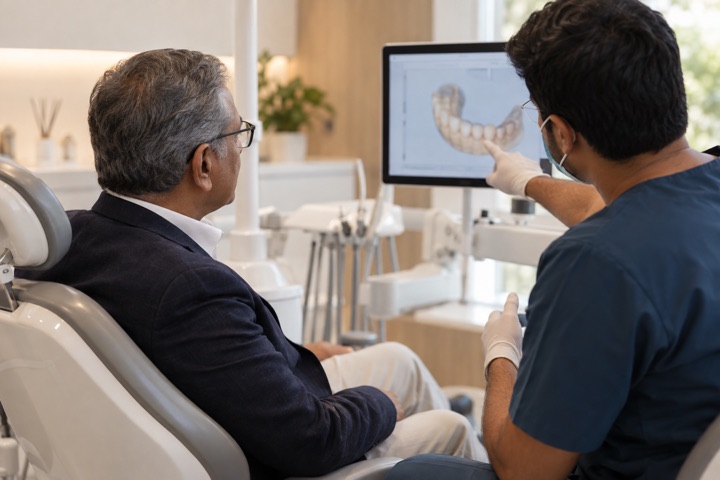
Examination, your medical history, and a CBCT scan taken here to measure the bone and see the nerves and sinuses near it. The doctor explains whether an implant is suitable and what the alternatives are.
Placing the implant
The post is placed in the jawbone under local anaesthetic, usually with a stitch or two. Where the bone is thin, a bone graft may be needed beforehand, which adds a stage. Where treatment needs it, the area is numbed with a local anaesthetic before we start, and you can ask us to pause at any point.
Healing
The bone grows onto the implant over a healing period of some months. A temporary tooth or denture can usually be worn so there is no visible gap.
The replacement tooth
An impression is taken and a crown is made in a laboratory and fixed to the implant. Several implants can carry a bridge, or hold a denture firmly.
Looking after it
An implant needs the same daily cleaning and check-ups as a tooth. The gum around an implant can become inflamed in the same way gums around teeth do.
How it feels afterwards
After placement expect some swelling, bruising and ache for a few days, eased by painkillers as advised; eat soft food and keep the area clean as shown. Stitches are usually removed about a week later. Not smoking during healing matters.
What decides the cost
A fee is only worked out once the doctor has examined you. It depends on:
- How many implants are placed.
- Whether bone grafting or a sinus lift is needed beforehand.
- What goes on the implant: a single crown, a bridge, or a denture; and the laboratory work.
- It is usually a staged plan, with the cost of each stage told to you in writing before anything is done.
What people ask about implants
It is done under local anaesthetic, and most people say it is less uncomfortable than they expected, often less than an extraction. The days after are usually manageable with painkillers. Where treatment needs it, the area is numbed with a local anaesthetic before we start, and you can ask us to pause at any point.
Someone whose jaw is still growing, whose bone or gums are not healthy enough, or whose healing is likely to be poor because of smoking, uncontrolled diabetes or certain medicines. Some of these can be improved before treatment. The doctor tells you honestly if an implant is not the right choice, and what is.
With good cleaning and regular check-ups an implant can serve for many years, but it is not for life by default. The gum and bone around it need the same care as around a tooth, and the crown on it can wear or chip like any crown.
Something else? , or call +91 98676 77249.
Ask about implants
Tell the doctor which tooth is missing and send any old X-rays, on a short call before you visit.