
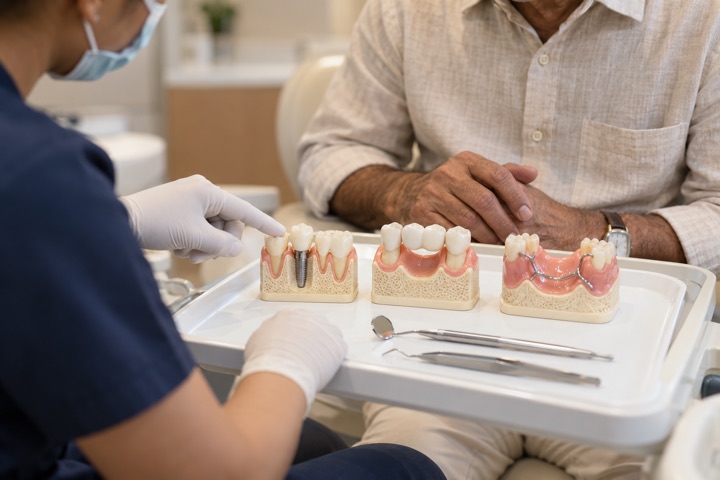
A missing tooth is common. It might have been taken out because of decay or a crack, lost in an accident, or never grown in. What matters now is what the gap does over time, and which of the three options suits you.
Why a gap matters
Teeth hold each other in place. When one goes, the teeth beside the gap can tip or drift into it over the months and years, and the tooth that used to bite against it can slowly move too. That can make cleaning harder and change the way your teeth meet.
Chewing usually shifts to the other side, which puts more work on those teeth. And the bone that held the root tends to shrink a little once there is no root in it. This is gradual, and it isn't a reason to panic, but it is one reason not to leave a gap for years if you'd rather keep your options open.
Not every gap needs filling. A missing tooth right at the back, with nothing drifting and chewing that's comfortable, can sometimes be left. That's a conversation to have at an examination.
An implant
An implant is a small titanium post placed in the jaw where the root used to be. Over some weeks the bone grows around it, and then a crown is fitted on the post. It stands on its own, so the teeth on either side are left untouched.
It tends to suit people who have enough healthy bone and gum in that spot, who have healthy gums elsewhere, and who are happy with a treatment that takes place over several visits. Smoking and uncontrolled diabetes can make healing less predictable, and we'd talk about that honestly. More on implants.
A bridge
A bridge is a false tooth held in place by crowns on the teeth on either side of the gap. Those neighbouring teeth are shaped to take the crowns, and the bridge is cemented in as one piece. It's fixed: you don't take it out.
It tends to suit people whose neighbouring teeth already have large fillings or crowns and would benefit from being covered anyway, or who would rather not have surgery. If the neighbouring teeth are untouched and healthy, shaping them is a real trade-off, and that's part of the conversation. More on crowns and bridges.
A denture
A partial denture is a removable plate that carries one or more false teeth and rests on the gums and the remaining teeth. You take it out to clean it and usually at night. A full denture replaces all the teeth in the upper or lower jaw.
It tends to suit people with several teeth missing, people who would prefer to avoid surgery or shaping other teeth, and people who want something that can be adjusted or added to later. It takes a little getting used to, and it can feel less secure than a fixed option, especially in the lower jaw. More on dentures.
What decides the choice
- Bone and gums. An implant needs enough bone to hold it and healthy gums around it. Where bone has shrunk, there are ways to build it, but that adds time and steps.
- The neighbouring teeth. Healthy, untouched neighbours argue for an implant or a denture. Neighbours that already need crowns make a bridge more reasonable.
- How many teeth are missing. One gap is different from several. Larger gaps often point towards a denture, or implants supporting a bridge.
- Time. A bridge or a denture is usually quicker from start to finish. An implant is spread over months while the bone heals.
- Cost. The options differ in cost, and the difference depends on how many teeth, which materials, and whether any bone work is needed. You'll have the figure in writing before anything starts.
- Your general health and habits. Some conditions and medicines affect healing. Tell us what you take.
What happens at the consultation
We examine the gap, the teeth beside it and your gums, and look at how your teeth meet. A CBCT scan, a 3D picture of the jaw, is taken here in the clinic if an implant is being considered, because it shows how much bone there is and where the nerves and sinuses sit.
Then we go through the options that fit your mouth, with what each involves, how many visits, and the cost. You'll get that as a written plan to take home. Nothing is done at that visit unless you ask for it.
When to come in
Sooner rather than later, if you can. A gap is easier to plan for before the neighbouring teeth have moved. If a tooth has just been taken out, the gum needs some weeks to heal before a fixed option is fitted, but the planning can start straight away.
If the gap is from a tooth that broke or became infected and you still have pain or swelling, deal with that before anything else.
If you are in pain and cannot reach the clinic, or you have swelling that is spreading, a fever, or difficulty swallowing or breathing, go to a hospital emergency department straight away.