
- Home
- Treatments
- Crowns and bridges
Crowns and bridges
A crown covers a weak or broken tooth; a bridge fills a gap using the teeth on either side.
Signs you might need it
- A tooth that has broken or cracked, or one worn down by grinding or acidic food.
- A large old filling with not much tooth left around it.
- A back tooth that has had root canal treatment.
- A gap of one or a few teeth, with sound teeth on either side of it.
What happens, step by step
Examination and the options
A CBCT scan to check the root and the bone. The doctor explains whether a crown is needed or a filling would do, and for a gap, how a bridge compares with an implant or a denture.
Preparing the tooth
The tooth is shaped to make room for the crown, and an impression is taken for the laboratory. A temporary crown protects the tooth in the meantime. Where treatment needs it, the area is numbed with a local anaesthetic before we start, and you can ask us to pause at any point.
Making the crown
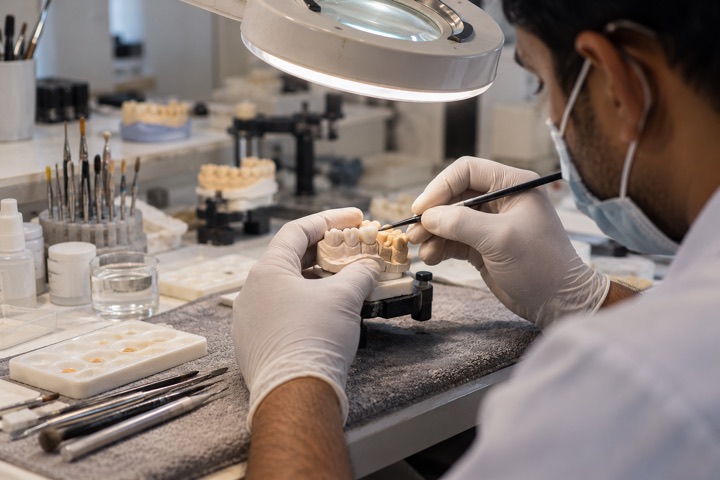
The crown is made in a dental laboratory, in porcelain, zirconia or metal-ceramic depending on where it is and how you bite, so there is a wait between visits.
Fitting
The crown is tried in and checked for fit, bite and colour, then cemented. For a bridge, the teeth on either side of the gap are prepared the same way and the replacement tooth is joined to crowns on them.
How it feels afterwards
If the tooth was numbed, it will stay numb for a few hours. Some sensitivity to cold and a bite that feels slightly different for a few days are common and usually settle. Clean under a bridge daily with floss threaded beneath it or an interdental brush, as food collects there.
What decides the cost
A fee is only worked out once the doctor has examined you. It depends on:
- The material the crown is made from.
- How many teeth are involved: a bridge is counted in units.
- Whether the tooth needs root canal treatment or a post to build it up before the crown.
- The cost is told to you in writing before anything is done.
What people ask about crowns and bridges
Where enough of the tooth remains, a filling is simpler and keeps more of the tooth. Where a lot has been lost, or the tooth has cracked or been root-treated, a filling may not hold and a crown protects what is left. The doctor shows you which applies.
It depends on the material, how you bite, and how well the tooth and the gum around it are kept clean. A crown does not stop decay at the margin, so check-ups still matter.
Those teeth are shaped to carry the bridge, which removes some enamel and is not reversible. That is the trade-off. An implant avoids touching the neighbouring teeth but needs a small operation, healthy bone and a healing period. The doctor explains which suits your mouth.
Something else? , or call +91 98676 77249.
A tooth that is broken or worn?
Show it to the doctor on camera, or send a photo, on a short call before you visit.