
Healthy gums don't bleed when you brush them. If yours do, the most likely reason is gingivitis: inflammation of the gum caused by plaque sitting along the gum line. It's common, it's usually reversible, and the fix is mostly in your hands.
What is usually going on
Plaque is the soft, pale film that builds up on teeth through the day. Where it sits against the gum, the gum reacts: it becomes slightly swollen, redder, and bleeds easily when touched. That is gingivitis. It often doesn't hurt, which is why people put up with it.
If plaque is left long enough it hardens into tartar (calculus), which a brush can't remove. Tartar keeps the gum inflamed and gives new plaque somewhere to hold on, so the problem tends to settle in rather than clear up.
What to do at home
Keep brushing. The instinct is to go gently on the bit that bleeds, or to avoid it, and that's the one thing that makes it worse. The bleeding is a sign of plaque, and the plaque needs removing. With steady cleaning, gums usually stop bleeding within a week or two.
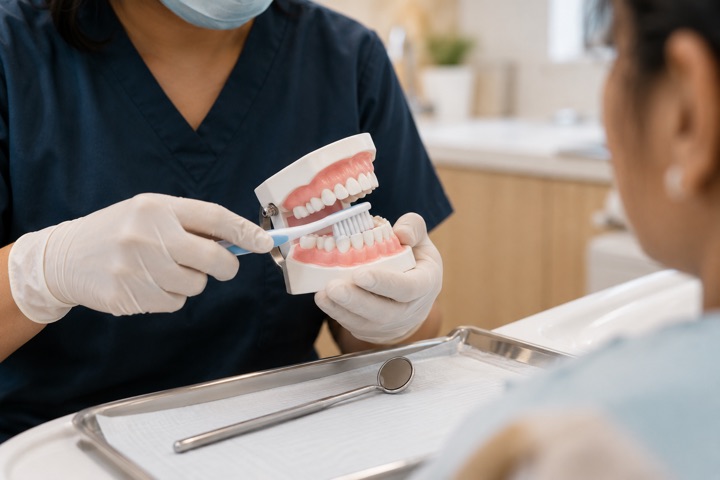
- Use a soft brush, and angle the bristles towards the gum line, where the tooth meets the gum. Small movements, tooth by tooth, twice a day. Scrubbing hard doesn't clean better; it wears the gum away.
- Clean between the teeth once a day. A brush only reaches the outside, inside and biting surfaces; the sides between teeth are where plaque hides. Floss or small interdental brushes both work. The gums there may bleed at the start too, and that settles the same way.
- A fluoride toothpaste is enough. Mouthwash is optional and doesn't replace cleaning between the teeth.
- If you smoke, be aware that smoking can hide bleeding by reducing blood flow to the gums, so gums can be unhealthy without the warning sign.
When it's more than inflamed gums (gingivitis)
If inflammation goes on for long enough, it can move from the gum into the bone and fibres that hold the teeth. That is periodontitis. The gum pulls away from the tooth, forming pockets that trap more plaque, and the bone slowly loses height. Unlike gingivitis, the lost support doesn't grow back, which is why catching it early matters.
Signs that it may have gone further than gingivitis:
- Gums that have receded, so teeth look longer than they used to.
- A tooth that feels slightly loose, or teeth that have started to shift or gaps that have opened.
- A bad taste or bad breath that brushing doesn't clear.
- Pus, or a gum that is tender and swollen around one tooth.
- Bleeding that carries on after two or three weeks of careful cleaning.
If any of these fit, come in. Periodontitis can be stabilised, and the earlier the better.
Pregnancy, medicines and other factors

Hormone changes in pregnancy can make gums react more strongly to plaque, so bleeding is common in the second and third trimester. The answer is the same careful cleaning, and a check-up is sensible; routine dental care is generally safe in pregnancy.
Some medicines can make gums swell or bleed more easily, including some blood thinners and some blood pressure and epilepsy medicines. Diabetes that isn't well controlled can make gum disease harder to manage. None of these is a reason to stop a medicine; they are a reason to tell us what you take.
Crooked teeth, a filling or crown with a rough edge, and mouth breathing can all make a particular spot harder to keep clean. Those are things we can see at an examination.

What the dentist does
We look at the gums, measure the pockets around the teeth with a small probe, and note where they bleed. If there is tartar, it is removed with a scale and polish (a professional clean), including just below the gum line. We show you where the plaque is collecting and how to reach it, because the cleaning you do every day matters more than the clean we do a few times a year.
If the pockets are deep, a deeper clean under local anaesthetic may be needed, sometimes spread over two or three visits, and we'd see you again after a few weeks to check how the gums have responded. More on gum care and check-ups and cleaning.
When to come in
- Bleeding that hasn't settled after two or three weeks of careful cleaning.
- Any of the signs above: receding gums, loose or shifting teeth, a bad taste, pus.
- If it has been more than a year since your gums were checked.
- If you're pregnant, diabetic, or on a medicine you think may be affecting your gums.
Bleeding gums alone are not an emergency. A swollen, painful gum around one tooth is different, and worth a call.
If you are in pain and cannot reach the clinic, or you have swelling that is spreading, a fever, or difficulty swallowing or breathing, go to a hospital emergency department straight away.